MANAGEMENT OF FILTH FLIES
WITH
PARASITIC WASPS
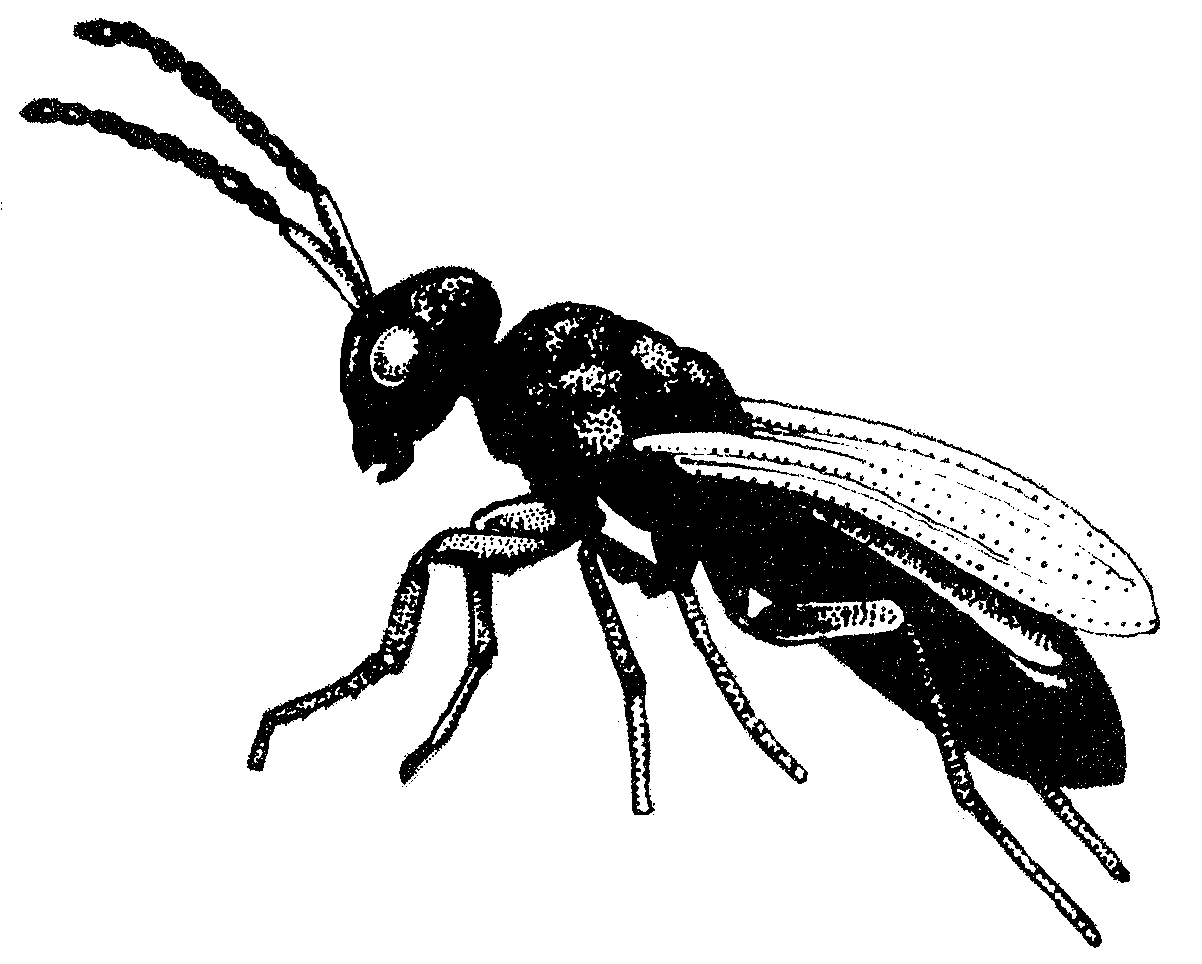
Rincon-Vitova Insectaries grows several species of tiny Muscidifurax and Spalangia wasps that attack fly pupae. Besides being extremely effective, they are virtually unnoticed by humans or animals. Mixtures are adapted to different climates with a higher proportion of Spalangia in proportion to Muscidifurax as seasonal temperatures rise. These Pteromalid parasitic wasps have a biological radar for finding fly pupae in manure and other fly breeding sites.
In 1972, the Rincon-Vitova team led by Everett Dietrick with University of California at Riverside colleagues pioneered mass-rearing of fly parasites, that have since helped reduce or end the need for pesticides for flies.
|
 |
There are many beneficial insects that destroy all life stages of flies. Beetles and mites
devour fly eggs and larva and the adult fly stage is partially controlled by natural disease. Fly parasites and Hister beetles are two natural enemies of flies that it is feasible to mass produce. A successful fly control program includes conservation of all the natural enemies of flies as well as elimination of habitat and trapping of adults as needed. We call this our three-pronged approach.
The key to a successful fly parasite releases is to start early, and make scheduled releases throughout the fly breeding season. Use of supplemental control methods such as sugar baits, fly traps, manure and breeding habitat management, etc. help greatly to reduce the number of commercial fly parasites needed. Factors influencing the quantity of fly parasites to release in a particular site include the season of the year, weather conditions, suitability of manure or breeding media, number of animals in a particular area, migration of adult flies into the control area, etc.
To release the fly parasites, keep them in a warm place, about 70 to 80 degrees, and check for emergence from the fly pupal casing by simply opening the paper bag and looking for the small ant sized parasites moving around. When you see several crawling inside the bag, sprinkle the contents in the fly breeding area, such as manure piles or moist areas. Fly parasites are packaged in units of 10,000, minimum orders of 5,000 or in bulk units of 50,000 and 120,000. Most users receive shipments at intervals of 2 to 4 weeks. The following topics describe our three-pronged approach to biological fly control using fly parasites.
HOW FLY PARASITES WORK - PRONG #1
Parasitic wasps lay
their eggs inside fly pupae and the developing flies provide food from within for the
young wasps. In addition, adult parasites "host feed" by drawing fluid from fly
pupae, and thus prevent the fly from fully developing. They are very effective against the
housefly, biting stable flies, garbage flies, and the lesser housefly, which comprise 95
percent of the flies in manure accumulations. They also parasitize the other 5 percent of
flies, such as horn flies, flesh flies, face flies and false stable flies, but control is
less complete on those flies which complete their life cycle widely dispersed in the
pasture. The parasitic wasps only attack flies and will not bite, sting, swarm or bother
anything else. They are nocturnal and are rarely seen during the day. Fly parasites
operate to a depth of 8 inches in manure, homing in with their biological radar on fly
larvae that are about to pupate.
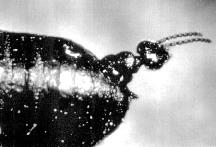
Fly Parasite Emerging from Pupa
Fly parasites complete a
generation every 3 weeks (from parasitism of the fly pupa to emergence of the adult),
yielding a steady reproduction of parasites. The adult wasp lives about 10 days. The
parasite populations increase geometrically and reductions in flies can be expected in 4
to 6 weeks. They are designed to find and kill the last fly at your location. However, flies
still can be migrating in, hence, biological control works best if the whole
neighborhood uses it.
|
REDUCE THE NUMBER OF ADULT FLIES - PRONG #2
|
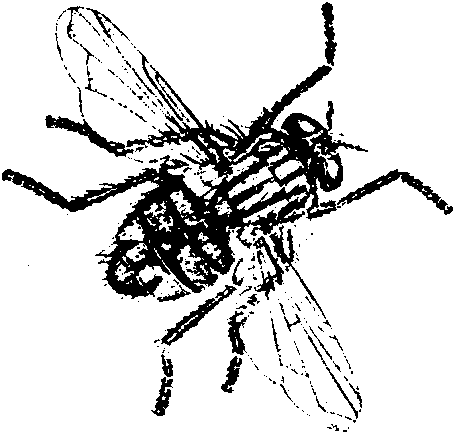 |
A successful fly control program keeps the number of adult flies down. Why? A single fly will lay up to 800 eggs, but a single parasite will attack less than
50 fly pupae developing from all those fly eggs. Flies also have an advantage of a shorter
life cycle (8 days in hot weather up to 14 days in moderate weather) giving greater
reproductive capability, and are able to travel greater distances. Flies resist the
effects of pesticides more than do the parasites. Because the fly has the edge, the
population of fly parasites needs continuous reinforcement through augmentative releases
of insectary-grown parasites to maintain a high level of fly control.
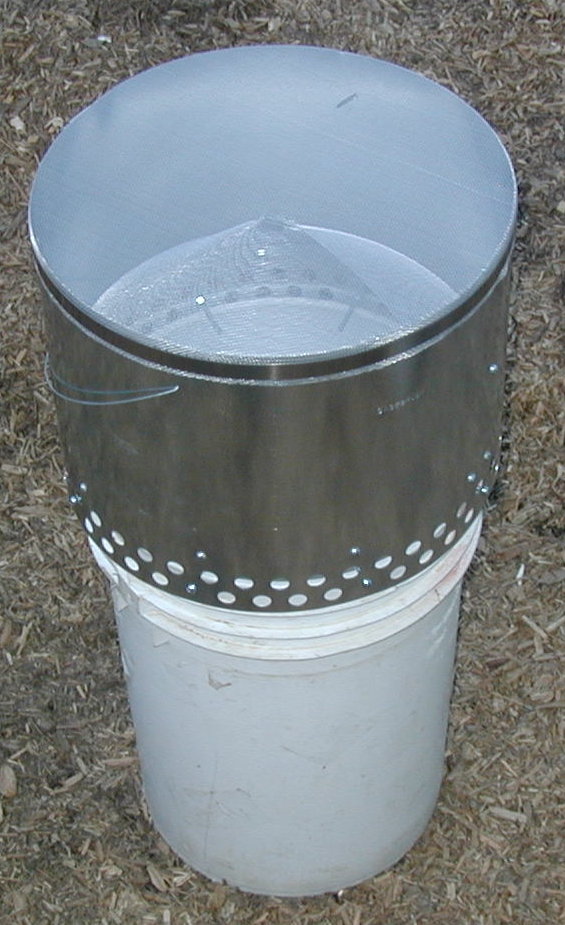
Example of a Medium Sized Fly Trap - Sagebrush S3
MANURE MANAGEMENT - PRONG #3
Sanitation to eliminate conditions favorable to fly breeding helps limit flies. Frequent
manure removal helps, but leaving a little of the top layer of manure in
place saves some of the complex of beneficials that helps kill flies.
Maintain ventilation, keep manure dry and eliminate wet areas where possible.
Large amounts of manure
can be managed in a pond or storage where non-aerobic digestion is accomplished or by
aerobic composting systems. Unprocessed manure can be piled and covered. This reduces the
surface; heat builds up to reduce fly breeding. Dry manure does not breed flies. The
interface between wet and dry manure that has a moisture content of 50 to 80 percent is
where flies breed. This is also where fly parasites work.
ESTIMATING NUMBERS OF
PARASITES NEEDED
Parasites are counted by the number of parasitized pupae adjusted by a factor of 25% (a maximum number of fly pupae that were killed without yielding parasites). In Rincon-Vitova's standard mixture of solitary and gregarious species, the average yield of parasites is 2 for each fly pupa. Bear in mind, however, that species ratio is also important. The more Spalangia and Muscidifurax raptor and zaraptor in the mix, the lower the total number of parasites, but the better the diversity for tolerating hot and cool weather, respectively. Therefore, though the average yield per FP10 (10,000 fly pupae) is 20,000, we guarantee a minimum of 15,000 wasps for any of our mixes.
Ironically the cost to produce a mixture of wasps with a higher proportion of valuable species, such as Spalangia spp., results in fewer total numbers of wasps, but is a higher quality product in hot, arid conditions. By contrast, a higher proportion of Muscidifurax raptorellus yields several times the number of wasps, but their tolerance to temperature extremes is less. Factors affecting recommended
numbers of parasites include numbers of flies, amount of manure or other organic matter,
moisture content, humidity, temperature, existing beneficial controls, chemical usage, use
of bait traps and incoming migrations.
Starting guidelines are
based on 500 to 1,000 parasites per large animal per month depending on concentration of
manure and 2 parasites per small animal per month, doubling up when fly problems are
severe and cuffing back when the parasites are well-established and the weather is cooler
and drier.
Schedules and numbers of
colonies (FP10) used in some typical schedules during fly season:
Stables (up to 30 horses) 1-2
colonies/month scheduled every 2-4
weeks.
Feedlots (appr. 1,000
head) 5-14 colonies/month scheduled every 1-2
weeks.
Dairies (appr. 100 cows) 3-7
colonies/month scheduled weekly.
Poultry (appr. 10,000
breeders) 2-4 colonies/month scheduled every other
week.
Poultry (appr. 10,000
layers) 1-3 colonies/month weekly or biweekly as manure piles up.
Compost (per 100 cubic
yards) 5-15 colonies/month scheduled weekly or biweekly.
To develop a basic release program, increase or decrease suggested release rates based on these factors:
| Factor |
Increase |
Decrease |
| number of flies |
high |
low |
| manure or organic matter |
a lot |
little |
| manure moisture content |
wet |
dry |
| control measures established |
no existing program |
good program |
| rain |
regularly |
little |
| humidity |
damp |
dry |
| drainage |
could be better |
good |
| animal watering equipment |
leaky |
no leaks |
| temperature |
hot |
cool |
| existing biocontrols (i.e. beetles, mites & fungi) |
few |
many |
| bait traps |
don’t use |
use |
| flies migrating in |
yes |
no |
| flies hauled in (i.e. to composting sites) |
yes |
no |
| comfort level with flies |
low |
higher |
| neighbor’s comfort level with flies |
low |
higher |
| budget for control |
good |
low |
| health concerns |
yes |
no |
TIMING RELEASES
It is easier to prevent
a build-up of flies than to get rid of them. A few flies always survive the cold and
drying conditions of winter in the pupa stage. Parasite releases should be made early each
spring at the first sign of emerging or immigrating adults to minimize the numbers of
adult flies laying eggs. Very early releases can be smaller in number, increasing in
quantity at the first signs of active breeding. Once established fewer parasites are
needed to maintain an effective number. A few may overwinter outdoors, but yearly
augmentation is necessary.
PUTTING PARASITES OUT
These parasitic wasps arrive developing inside the fly pupa. When fully grown, they cut a hole in the pupa case and exit as adults searching for more fly larvae, seeking to lay their eggs where the flies pupate. The date on the bag is an estimated emergence date.
Sprinkle a small handful or spoonful of the parasitized fly pupae in wood shavings either on manure or in furrows and lightly cover to protect from birds. The widest possible dispersal around fly breeding areas is best.
Locating the fly breeding sites is critical to using the fly parasite effectively for fly control. Fly parasites should be released around any area where maggots are seen. Places to look for these sites are in and around coops, kennels, barns, stables, and stalls, with special attention to maternity, hospital and calf pens on dairies and fence lines and feed bunks on feedlots, and wherever straw bedding is provided for animals. Place also around corral posts, fence lines, paddock areas, and other dropping sites, at the edges of manure piles, pits or carts, and wherever manure accumulates. Other fly-breeding areas are near (but never directly in) water sources and decomposing matter in garbage cans and septic tanks.
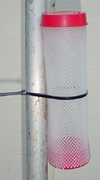
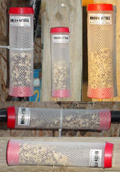
Rincon-Vitova's fly parasite release stations are more popular than ever both for the protection of fly parasites from predators such as birds and rodents, but they also make it easier to train helpers to distribute a standard amount where you want.
More information on fly parasite release stations
|
|
| Fly Parasite Release Station on Post |
Mounting Fly Parasite Release Stations
Using a Wire Bail, Zip Tie or Cable Tie |
HANDLING OF PARASITES
Fly parasites must not
be left in direct sunlight or hot areas. If ordered fresh, they may be held at 70° -
80°F, increasing to 85 ºF for more rapid emergence; otherwise, they are emerging and
ready to release within a day or two. Cold storage shortens life and may harm
reproduction. Avoid chemical sprays within 48 hours of release. Rincon-Vitova offers
screen mesh packaging for hanging in barns where floors are washed regularly or predation
by rodents is likely.
FLY TRAPS
Bait traps are economically and safely used to trap large numbers of adult flies without interfering with biological controls. Lowering the adult fly density before seasonal hot weather arrives and during the period of time that it takes for the beneficials to reproduce to larger numbers in the manure results in less fly problems during the first few weeks of summer. Some chemicals or nonpoisonous materials also come as sugar baits and fed to the adult flies.
In humid areas and in wet manure accumulations, especially where manure is washed into pits, it takes both releases of parasites and bait stations to give excellent fly management. Set up one bait trap inside each barn or shady area when you start releasing parasites. The number of traps should be increased along with parasite releases until adult flies are gone.
More about traps and fly lures
MONITORING EFFECTIVENESS
To assess the parasitism
of fly pupae in manure, fly pupae can be separated from the manure by flotation. Agitation
will float the pupae to the surface. Pupae that are old enough to have been exposed to
parasitic wasps change from reddish to dark brown. Up to ten percent of these will not
develop into flies. Those yielding flies have the end of the pupal case broken off. Neatly
cut escape holes are evidence of parasitism. Check 100 dark brown pupae in a week for
parasitism and dead intact pupae to get parasitism rate and possible parasite-induced
mortality rate.
Since adult flies are
the pest, a reduction in the number of adult flies is the best measure of a successful
integrated fly control program. Fly tapes hung to attract and count changes in adult fly
populations work best.
INTEGRATING WITH HERBAL OILS OR CHEMICAL
CONTROLS
Biological control works
because of the entire complex of insectary-grown and naturally-occurring predators and
parasites of all stages of flies. All natural enemies of flies are susceptible to
pesticides, particularly when directed at manure. Reduce adult populations with poison
baits. Spray only adult fly resting areas with long residual pesticides; never spray breeding sites directly. This way you will
conserve the natural enemies, prevent the development of resistance and reduce toxic
pollution.
Herbal essential oil sprays used regularly on animals to repel adult flies and suppress lice may may also kill insects in direct contact. One example is Ecto-Phyte from Agri-Dynamics in Martins Creek, PA . Current price is $60 per gallon but a little goes a long way of this high quality mix of vegetable and essential oils.
SUMMARY OF HELPFUL HINTS
1. Release enough fly parasites early,
when flies appear and before it warms up.
2. Disperse parasites widely.
3. Trap adult flies.
4. Clean manure leaving a pad or reserve
where beneficial organisms have built up.
5. Eliminate wet areas where
possible. Use hydrated lime where animals urinate frequently. Keep manure dry with good
ventilation and clean up feed spills where possible.
Rincon-Vitova Catalog of Fly Control in PDF
Catalogo de Controle de Moscas (Spanish version of Catalog) in PDF
Fly Traps
Sagebrush Fly Traps
Final Flight Fly Traps
Farnam Fly Traps
Biting Fly Traps
Olson Traps
Make Your
Own Adult-Fly Bait Station - Easy And Effective
To get started, find a medium to large plastic bucket and some fiberglass window screen approximately
24 in. by 42 in. You will also need a dowel or narrow stick approximately 3
ft. long, and some twine or duct tape.
To set up the bait, you need a quart of molasses in three quarts of water.
To complete the station, a can of dry poison fly bait at the feed store and spray bottle of water.
Then -
1. Wrap fiberglass screen around
bucket and overlap (fold over twice to seal seam).
2. Fasten lower edge of screen to top
edge of bucket with twine or tape to keep flies out! If adult flies enter, they will
contaminate the molasses attractant so it won't last as long.
3. Mix well 1 quart of molasses in 3
quarts of water in bottom of bucket to serve as a fly attractant. Replace water lost by
evaporation in molasses solution when necessary.
4. Place dowel stick In bucket to
support screen, then fold over top edge of screen to seal.
5. Using tap water in spray bottle, wet
screen all around.
6. Sprinkle wet screen with DRY fly bait
so bait sticks to screen. Replace bait as needed.
7. Place bait station in areas where
flies congregate and move to determine best site— shady locations In summer and sunny
locations In winter. Station may be hung out of the way by attaching wire with hook to the
sides of bucket.
8. This bait station functions without
care for up to 5 weeks provided molasses mix continues to grow yeast Instead of putrefying
bacteria.
---Keep station out of reach of children
and pets.
---Label station "POISON!"
---Follow safety precautions on fly bait
label.
—Wash hands after work with the
station.
Adapted from Agricultural Extension
Bulletin, San Bernardino County, CA, June 1974.
Fly Parasite Product
Information
Minimum Contents: 7,500, 15,000 or 75,000 fly parasites (from 5,000 or 10,000 or 50,000 pupae); 75% minimum parasitism; no
live flies. Approximately 50% wood shavings by volume.
Description: Small parasitic wasps
are shipped developing inside fly pupae; some adults are emerging on delivery unless
otherwise requested. Wasps will only attack fly pupae and do not bite, sting, swarm,
infect or otherwise bother humans or animals. Wasps usually search under surface of
decomposing organic matter.
Storage: Storage shortens life and may reduce reproductive capacity. If release must be delayed, open box and hold at 50'F (10'C) and 40-60% RH with good air circulation for only a few days.
Guarantee:
Alive and in good condition. Open package and report any problems immediately.
Sex Ratio: M. raptorellus and M. zaraptor, ,
60% female; S. cameroni, 60% female
Host Pests: Housefly, biting stable
fly, garbage flies and lesser houseflies, etc.
Development: Egg to adult life span is 16 or more days depending on temperature.
Program Guidelines:
Used for augmenting the natural
enemies already at work in decaying organic matter
Start at first sign of flies and keep
up with regular releases till fall
Quantities can start low and increase
with warm, wet or humid weather
Clean out manure at least weekly in
areas where fly breeding occurs
Leave edges of organic matter to
conserve breeding parasites
Trap adult flies to reduce quantities
of parasites needed for release
Plan for an average of 250 parasites
per large animal, or 1 parasite per bird per week
Release Guidelines:
Hold at 60º to 90º F (15º to 32º C) with good air circulation. Keep out of direct sun.
Ready to release immediately or within
48 hours unless receiving unincubated pupae.
Sprinkle widely around edges of
organic matter where flies lay eggs and pupate.
Pouches of mesh or plastic can be used
as release stations where damage or predation is likely.
Parasites are most effective around
areas where flies are breeding (indicated by presence of maggots)
Pesticides: Susceptible to
pesticides, particularly when directed at manure. Careful placement of pesticides
minimizes harm. Reduce adult fly populations with traps or poison baits. When applying
pesticides with long residual activity, spray only adult fly resting surfaces to minimize
the impact on the parasites.
New Organic Pesticide Available: Balence contains a naturally occuring fungus that eats flies. Simply mix with water and fog areas with adult flies. This has very little effect on beneficial insects and wildlife such as birds, frogs, and lizards.
See also
Organic Fly Control
Lures for Fly Traps
Rincon-Vitova Catalog of Fly Control in HTML
Catalog of Fly Control in PDF
Catalogo de Controle de Moscas (Spanish version of Catalog)
in PDF Other Organisms for Fly Control - Catalog
USDA and EPA Regulatory Issues
Sagebrush Fly and Yellow Jacket Traps For Outdoor Use - Catalog
Sagebrush Trap Information
Odor Management
|