|
Lacewing Bulletins, Chrysoperla (=Chrysopa)
Green Lacewing Technical Bulletin
Applying Lacewing Cards
Notes on Release of Hatching Lacewing Eggs from Plastic Squeeze Bottles
Applying Lacewing Verticel Honeycomb or Larva Units
Farming With Green Lacewing
More Approaches for Releasing Lacewing for Orchards, Vineyards, and Landscaping
Los Chrisopidos Verdes Spanish - Green Lacewing
Green Lacewing Technical Bulletin
| Description:
A beneficial predatory insect that attacks insects and insect eggs, such as aphids, small caterpillars, mites, whitefly, scale, mealybug, thrips, psyllids, and other soft-bodied insects.
|
 Chrysoperla rufilabris Chrysoperla rufilabris |
Lifecycle: At 80º F (27º C), larvae emerge from eggs in 3 to 5 days from date of shipment. Larvae can walk up to 7 miles. They move from plant to plant if leaves are touching - slower on rough or hairy foliage. For each 5 degrees higher temperature, larvae will clean up aphid infestations a week sooner (higher metabolism makes them eat more). Temperature of at least 60º F (15.5º C) is required for significant eating and egg-laying.
 |
Larvae are predators for 2 weeks (or longer if nights are cool).
Cocoons yield adult green lacewing in about 5 days.
Adult lacewing migrate toward nectar, pollen or insect honeydew before laying eggs. Sugar sources attract adults.
Eggs are laid on hair-like filaments – up to 600 eggs per adult |
Release guidelines:
On slow-growing plants: one larvae for each 50 prey
On fast-growing plants: one larvae for each ten prey
On aphids in greenhouse flats: five to 20 hatching eggs per square yard
In orchards and row crops: 2,000 to 30,000 hatching eggs released two to four times every seven to 14 days
Frequency and quantity of releases also vary with size and type of plant, number and type of pests, other predator and parasite populations, and temperature.
To hold for later release: If you think you will need to hold the larvae for more than a day, you can order frozen sitotroga eggs to feed them (when you order the lacewing larvae). Place the honeycomb unit on a flat surface. Sprinkle the eggs on top of the organdy material on the honeycomb. The larvae will reach through the material to feed on the eggs. Once a day tap off the eggs onto a piece of paper and sprinkle then back onto the top (to redistribute the eggs). Do not refrigerate. Refrigeration at this stage could damage the developing larvae.
Handling Lacewing Eggs:
-
Keep warm (75º to 90º F) [24º to 32º C] but out of direct sun and away from heaters that dry the air.Maintain relative humidity at 30-50% (not in plastic). Check each morning for emergence.If no larvae appear within 5 days of shipping date at 75º to 90º F, call supplier.Release within 24 hours of first signs of emergence.Sprinkle or blow into foliage or fasten cups or cards as close as possible to infestations.
-
Distribute as widely as possible.
|
Lacewing Packaging Options:
-
Loose eggs in increments of 5,000 and 10,000 in bags or cups with or without rice hulls or vermiculite and food.
-
Eggs glued on cards (2,500, 5,000, or 10,000/card) perforated to cut into 30 hangable units.
-
Pre-hatched larvae in cardboard honeycomb units (500 larvae/unit) come as first instar (young and small) or third instar (larger, faster and hungrier, that pupate sooner).
-
Pre-hatched larvae 1,000/bottle in rice hulls (2 week notice required).
-
Adults in cartons of 100 or 250 mated females with about 6 to 20 days of egg-laying capacity depending on temperature (must ship overnight).
|
Watch out that you don’t feed your lacewings to the ants - ask about RVI’s ant management products, such as AntPro boric acid sugar bait dispenser and bait mix.
GREEN LACEWINGS: NATURE’S BEST PREDATOR
Green lacewings are proven broad-spectrum biological control agents, devouring eggs and young larvae of Colorado potato beetles, flea beetles, most caterpillar (worm) pests (armyworms, budworms, bollworms, borers, corn earworms, cabbage loopers, codling moths, etc.), aphids, spider mites, scales, psyllids, mealybugs, whiteflies, thrips, leafhoppers and other pests. Adult green lacewings have light green bodies, golden eyes, lacy wings and are vegetarian - they eat pollen and nectar. Lacewing adults live longer and lay more eggs when provided nectar, pollen and insect honeydews. Eggs are laid in foliage on the tips of silk stalks. The grayish-brown larvae resemble miniature alligators, and are 3/8 inch long when full-grown. Larvae search out pests, and use their pincer-like jaws to seize, inject digestive enzymes, and suck juices out of pests.
During 2-3 weeks of life, one lone lacewing larva can consume 250 leafhopper nymphs in grapes (4th-5th instar), 300-400 aphids, 11,200 spider mites, 3,780 coccid scale crawlers or 6,500 scale eggs on pine trees. Interfering ants, waxy coatings or hard shells on pests and low temperatures deter lacewings from dining on and destroying pests.
About 1,200 green lacewing species are known worldwide. We currently offer Chrysoperla rufilabris.
CHRYSOPERLA RUFILABRIS is a reliable workhorse predator that has helped liberate many Rincon-Vitova clients from the pesticide treadmill over the last three decades. Best known in the Southern and Eastern U.S. for aphid control in tree (pecan) and field crops, C. rufilabris is also a valuable ally against tough pests like sweetpotato whitefly in cotton and crops from Texas to California. lacewing attacks over 100 insect and spider mite pests from lowland valleys to high mountainsand lay 10-30 eggs per day producing two to three generations per year.
Very light infestations of pests that make honeydew (e.g. whiteflies, mealybugs, aphids) should be tolerated, as they induce C. rufilabris to fly upwind into fields. Excellent egg laying stimulants include pea aphid honeydew and ice plant pollen.
Sunflower and corn borders provide shelter and dew water on hot summer days and corn pollen is a good late summer diet to encourage overwintering. Covercrops, weeds, dead leaf litter and bark are overwintering sites. Adults preparing to overwinter turn brownish-yellow and cluster together. German growers buy red or brown painted shelters stuffed with straw to attract overwintering lacewings.
LACEWING RELEASE BASICS
Since one lacewing can produce 40,000 progeny in 60 days, maximum benefits are obtained by starting releases very early in the season. A rough release rate is 5,000 to 50,000 green lacewings per acre per season or 1,000 per 2,500 square feet of garden. At least two early season releases two weeks apart are needed to foster overlapping generations (larvae, the pest-eating stage, are then most likely to be present). Populations are monitored by sweep net or vacuum sampling (D-Vac), counting eggs per random sample of plant material, or beating branches over trays for larvae. Rincon-Vitova ships green lacewings as eggs (loose or on cards or in bags), larvae (honeycomb units), pupae (honeycomb units), and adults.
Loose Lacewing Eggs Loose eggs are available straight or mixed with rice hulls as a disbursement or carrier material and reddish-brown food (frozen moth eggs) for early hatching larvae to eat before they are sprinkled or broadcast. Corn grit is a finer disbursement medium, but can dehydrate eggs and larvae if mixed too soon before release. It also has angular corners that can injure the young larvae.
Eggs hatch one to four days after delivery (eggs change color from green to gray-white on hatching). Holding eggs in an insulated box with a hot water bottle (80-90º F) and adequate air space speeds hatching. Release eggs when small larva are seen inside the bag or carton. Sprinkle some rice hulls (or other carrier) onto a white piece of paper. Wait a minute, then pour the rice hulls back into the bag. Larva will be evident walking on the paper. Release in early morning or evening and on misted foliage if possible and not in the presence of ants.
Sprinkle eggs as close to pest infestations as possible or place small amounts of eggs into paper cups and staple to leaves. A gasoline powered backpack sprayer, our bioapplicator, can be used to distribute lacewing eggs onto trees, vines, and row crops. See below.
Applying Lacewing Cards
Eggs may also be applied by salt shaker, squeeze bottle, leaf blower, vineyard cone funnel, ground rig, helicopter, fixed-winged aircraft, model airplane or balloon. Imagination is the only limit to developing distribution methods for loose eggs.

Lacewing Eggs on Cards Lacewing on cards are shipped with 2,500, 5,000 or 10,000 lacewing eggs glued on each card; cards are perforated to guide cutting or tearing into 30 of ¾ X 2 inch tabs with a hook on one end and containing about 86, 170 or 332 eggs. Cut and place tabs into vines, shrubs or trees when larvae begin to hatch. Tabs can also be placed inside small paper cups and either stapled to plants or hung by a knotted string (through bottom of cup). The cards can be further cut into smaller pieces for wider distribution.
To separate the tabs from the card, fold the card at the perforations. Grasp the card on the margins and pull the tabs apart. Or use scissors to cut apart. This can be done beforehand and the tabs placed in paper bags or other containers to carry into the field. Try to do this as soon as possible after you receive them. If you have some flexibility as to when you put out the cards, hold the cards at room temperature or higher, up to 95º F. When you see the first larva hatching, place the cards on your plants. This is best because it minimizes the time they are exposed to predators.
Open the hook and place on a twig or leaf of the plant to be protected. Place tabs on the sunny side of the tree covered by leaves a bit so they are not in the direct sun. Place as high in the plant as you can comfortably reach.
400 Lacewing Larvae in Honeycomb Units Lacewing larva feed on small prey such as mites and mite eggs for the first week before they are big enough to eat aphids. Pre-fed larvae in honeycomb offer a one week headstart (pest populations can double during a hot summer week) over eggs for combating pests. Also, larvae need less protection from ant predation than lacewing eggs. Releasing larvae on cool evenings and misting foliage may enhance survival. To release larvae, peel off the organdy cloth cover from the honeycomb unit a little bit at a time, and either tap larvae onto plants or use a fine paint brush to lift or brush Larvae onto plants (one larvae per mildly infested plant is a rough rule of thumb).

Larvae gobble up pests for two weeks before pupating, at which time a new generation of larvae may be released. Releasing 2nd instar larvae from coneycomb units provides the greatest and most immediate pest-eating action.
Adult Lacewings Adults are shipped in lots of 250-275 pre-fed females ready to lay eggs. Each unit has the potential to lay about 75,000 (C. rufilabris). Artificial diet may be needed to target adult egg laying and keep C. rufilabris in fields. Use Rincon-Vitova's Insect Food, or mix equal parts of dried brewer's yeast and sugar with water and spray on plants. Plants produce methyl salicylate (MeSA) when under attack by aphids. MeSA or wintergreen oil can be sprayed onto plants to draw in lacewing, ladybugs, and syrphid flies - aphid predators.
Lacewing Release Guidelines: Effective programs range from two to four releases seven to fourteen days apart at 1,000 or more eggs per 2,500 square feet or from 2,000 to 30,000 eggs per acre. With prefed larvae and adults, use 660 to 5,000 prefed larvae or 200 to 500 adults per acre or 100 trees.
Ants: are attracted to the eggs on the card. They will eat all the eggs on the card. Ants generally interfere with biological control, and in particular they attack and drive lacewing larvae away from aphids, whitefly, mealybug, and soft scale. These honeydew-secreting pests supply sweets to the ants. Put attention to controlling ants. One part of the strategy is to stick a shovel into ant mounds and disrupt the colony. Besides boric acid baits, two newer organic products that happen to help kill ants are Auntie Fuego soil conditioner and beneficial parasitic nematodes. Ask about our ant management products and information on Argentine ants.

Hot Spots: Pest outbreaks often occur in "hot spots" or edges of orchards or landscapes. Heat or dust from a road, exposure to nearby infested plants, or drying winds may shift the ecological balance of predator and prey in your plantings. Treating the hot spot or edge often is all that is needed to control the outbreak. The extent, situation, and location of the infested area will determine the best strategy.
Notes on Release of Hatching Lacewing Eggs from Plastic Squeeze Bottles
Cartons of lacewing eggs (50,000 to 200,000 per carton) are usually mixed "with food" (frozen moth egg diet) unless customer wants "straight eggs--no food". Cartons can be marked by collection date if requested. Older eggs may hatch a little faster. Cartons are packed in cardboard box and shipped second day service if customer wants eggs developing in transit, or in an ice chest with warm or cold packs and shipped by overnight service if weather is extremely cold or hot. Open cardboard or foam box same day to let air circulate around the cartons. Inspect at least a random sample of cartons to become familiar with appearance of eggs before and during incubation period.Timing of hatch is 2-5 days, but hard to predict unless temperature is controlled. We start incubating on arrival at 85º F; relative humidity should be above 35% RH if possible. Do not refrigerate eggs unless they were shipped very cold. You can hold them cooler, down to 60’ F to slow them down. You can manage the holding temperature of different cartons to stagger the hatch by 12-24 hours if desired.
Plastic squeeze bottles can be used to distribute hatching larvae along with predatory mites if desired for simultaneous release. A pint-size bottle can hold 1,000 mites and 5,000 - 10,000 lacewing per bottle for roughly 1/2 to 1 acre. Mixing When lacewing are between 25-50% hatching, mix the desired per-acre release amount gently in a cement mixer and fill the bottles using a funnel. Spoon roughly 1 ml hatching eggs or 2 mI if food was added (1/8-1/4 tsp or 5,000 eggs) per 250 ml corn grit or bran (2 cups or enough for one bottle). For 80 bottles of 5,000 eggs per bottle, mix 80 ml of hatching eggs (400,000 eggs) gently in 10 gallons of grit or bran. Corn cob grit can be ordered from Milihorn Chemical and Supply, Maywood, CA, 323-771-8301.
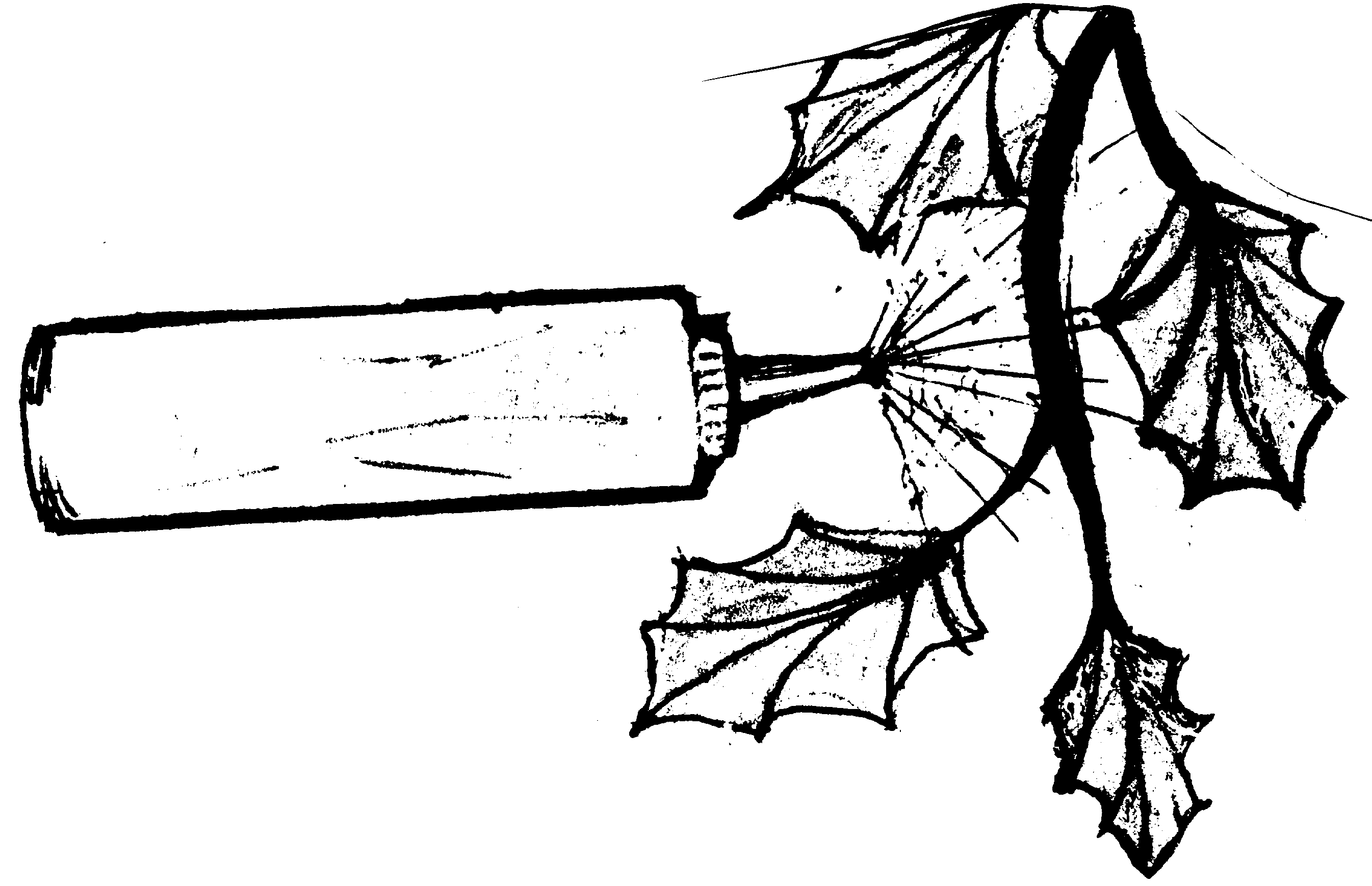 Calibrating bottles: Tips of bottles usually need to be trimmed slightly with a sharp knife so that grit or bran flows easily. Depending on the size of the opening, pint bottles hold approximately 300-500 puffs per bottle. Therefore, if you have 500 vines per acre, you would do 1 small puff per vine to finish a bottle 5,000 on one acre of edges and 1 puff per every 3-5 vines for the middles. It better to walk every other row releasing some in every row.
Releasing: Once they are mixed with corn grit, they must be released in the next 4 hours as corn grit can be desiccating. Time factor is probably not so critical with bran. Release in cooler parts of the day. Evening is good to give larvae overnight to find protection, but early is also good if there is dew, mist or water on the leaves.
Applying Lacewing Honeycomb or Larva Units
Green Lacewing Larvae in honeycomb units: This is the solution for lacewing larvae spot releases in trees, vines and bushes.
To make pre-hatched larvae easier to release in trees and vines, you can cut narrow strips of honeycomb (or verticel) honeycomb easy to cut into any size for spot releases. Just cut the honeycomb into about 1 inch strips, peel off the organdy net cover, snip the strip into the size units for each release spot, and hang the units with twist ties or rubber bands.Larvae will walk out of the paper honeycomb, out-running other predators better than larvae just out of the egg. They disperse through the tree or vine, voracious in their search of insects, mites and their eggs. Lacewing then pupate under leaves. The adults will continue to inhabit the farm or landscape that provides the pollen or nectar that the adults need to lay eggs. Reasons why pre-hatched and pre-fed larvae are the best form of green lacewing for pest hot spots:
• unlike adult predators, they cannot fly away• they can walk as far as 7 miles looking for pests and pest eggs• unlike larvae just out of the egg, pre-hatched larvae are big and strong enough to live a few days and walk a mile or more to find food (depending on the temperature)• unlike putting out lacewing eggs, the pre-hatched larvae are more able to fend off other predators and survive bad weather
• pre-hatched larvae are hungrier and eat more pests in one area without resting or moving on.
The elegant green lacewing is a general predator and will consume many soft bodied insects and their eggs, including mites and pest thrips. Lacewing is the most economical commercially available general predator for many different pest situations. Releasing lacewing eggs is easily done using lacewing egg cards.

Lacewing eggs are placed into honeycomb units - paper honeycombs - like a 1/2 thick slice of cardboard. Organdy material covers both sides. Food (non-viable Sitotroga grain moth eggs).
They are available with 400 larvae per honeycomb.
The honeycombs can be cut into smaller pieces for distribution. Use razor blade or sharp utility knife to cut the honeycomb into small pieces. A 1.25 inch square contains about 20 larvae. Place the pieces into a paper bag or other container to carry into the field. Once in the field next to a plant, pull the organdy material from one side of the honeycomb. Use a rubber band or twist tie to attach the honeycomb to a plant. Another way to release them is to walk to an infested plant, pull the organdy back a short distance to expose a few cells, turn the honeycomb upside down and tap the larvae out. Or use a small brush to flick one lacewing at a time onto a plant.
Place as high in the plant as you can comfortably reach.
Hot Spots: Pest outbreaks often occur in "hot spots" or edges of orchards or landscapes. Heat or dust from a road, exposure to nearby infested plants, or drying winds may shift the ecological balance of predator and prey in your plantings. Treating the hot spot or edge often is all that is needed to control the outbreak. The extent, situation, and location of the infested area will determine the best application method for your needs. Lacewing Adults: As a rule there is no better method for getting lacewing into tall trees than to release as adults. Adults will start laying eggs in five days. By planning releases early, the eggs laid by released adults are perfectly placed near prey suitable for the larvae. This is a popular program for aphid control in street trees where they can be colonized. To keep the adults in your area, providing flowering plants with nectar is essential. Check lists of beneficial insect attracting plants that grow in your area. Corn is an excellent source of nectar (from extrafloral nectaries) and protection for lacewing adults. Adults require special handling for shipping. Pupae in honeycomb cardboard units can be purchased which will emerge in a few days for release as adults (the pupal stage is about five days). Aerial Lacewing Egg Release: Aerial releases of eggs and larvae by airplane and by remote control airplane have been used, the problem being that many fall to the ground. Some crop dusters have created equipment similar to pollen applicators with a venturi mechanism out of the airplane floor. Passes are made across field rows in the early morning. The preferred carrier for mass field releases may be rice hulls. In indoor plantings, tethered helium balloons have been used with a "toy" scoop carrying the lacewing eggs in a carrier such as vermiculite. A release lever for the scoop is controlled by a separate string.
Backpack Biocontrol Applicator Release: The Rincon-Vitova Backpack Biocontrol Applicator, produced by Maruyama Corporation, is a multipurpose machine for delivering dusts, granules and liquids, including cover crop seeds, fertilizers, biologicals and pesticides. Either dry or liquid products are dispensed from the same 3.4 gallon (12.9 liter) chemical tank with only minor modifications.
Rincon-Vitova’s Biocontrol Applicator for lacewing eggs and other organisms.
This backpack mister/duster has been modified, tested, and calibrated by Rincon-Vitova for delivering biocontrol agents such as lacewing eggs, Trichogramma pupae in sitotroga eggs, predatory mites, and beneficial nematodes. Biocontrol materials can be applied in swaths up to 20 feet wide while walking.
Specialized attachments and a sticker material are available to customize the Backpack Biocontrol Applicator for different jobs, making this a very versatile tool.
Maruyama Biocontrol Applicator Features:
-
Air bubbler in the tank for organisms to live in liquid and keep them suspended
Vent in tank lid to release tank pressure created by bubbler
Normal walking movement keeps organisms in suspension
-
Instructions, calibration and test data for bran, vermiculite and various sticker solutions
-
Toll free 800 phone number technical support
Biosprayer Release: A spray rig with a PTO towed behind a tractor has been adapted for spraying on lacewing eggs. It has been used for large-scale releases but is not currently being manufactured.
Ants will fight off lacewing larvae from aphids they are protecting. Ants generally interfere with biological control, and in particular they will attack and drive lacewing larvae away from aphids, whitefly, mealybug, and soft scale. These honeydew secreting pests supply sweets to the ants. Put attention to controlling ants. The simplest thing you can do is to stick a shovel into ant mounds and disrupt the colony.
Ant Bait Station
Hot Spots: Pest outbreaks often occur in "hot spots" or edges of orchards or landscapes. Heat or dust from a road, exposure to nearby infested plants, or drying winds may shift the ecological balance of predator and prey in your plantings. Treating the hot spot or edge often is all that is needed to control the outbreak. The extent, situation, and location of the infested area will determine the best application method for your needs.
Farming With Green Lacewing
Ideally, releases of beneficials are started as early in the season as possible, when the first pests enter your fields or neighboring crops. One of our most popular strategies is initially releasing small numbers of beneficials to colonize young plants, and following up with a series of weekly releases to insure long-term establishment of pest-destroying natural enemies. Farming ecologically with biological control inputs gets easier each year, as a reservoir of natural enemies becomes established. The insect ecology of each farm and season is unique, but some general guidelines are available from research.
VEGETABLE CROPS
Green lacewings go after aphids on vegetables first, but also attack thrips, spider mites, whiteflies, moth eggs, young caterpillars and other pests as aphids are cleaned up. Numbers of lacewings needed depend upon many factors, including pest numbers, temperature, other natural enemies, etc.Studies in Finland using Chrysoperla carnea against bean and green peach aphids on parsley achieved control with a predator:pest ratio of 1:27 (230 eggs/m2). On green pepper a higher ratio of predators was needed, whereas on greenhouse asparagus, 40 eggs/m2 controlled green peach aphid for three months. "During the spring-summer period, the initial ratio of predator to prey should be 1:15 on most fast-growing crops, but 1:50 on celery and dill, and during the autumn-winter period it should be 1:10 on spinach beet, 1:25 on celery and 1:30 on lettuce." Fall cabbages with waxy aphids require 1:1 for 74% control, and 1:25-50 for 50% control. In USDA studies (Nordlund), lacewing larvae placed on potato plants when Colorado potato beetle (CPB) eggs begin hatching prevents damage (potatoes without lacewings are defoliated). Buckthorn aphid on potato was reduced up to 96% and green peach aphid 83% with 34,000 lacewing per acre; potato aphids were not affected. In the Ukraine, 2-3 releases of C. carnea (50-60,000 per year) at 10-15 day intervals were 85-96% effective against CPB on potato. On eggplant, similar numbers of C. carnea larvae released 3-4 times at 7-10 day intervals at a 1:20 predator:pest ratio were effective. Other pests, such as thrips, are also stopped on potato, eggplant, tomato, and pepper.
Releasing lacewing in borders of early crops (e.g. wheat, barley, sorghum, corn, sunflower, alfalfa, oilseed Brassicas) results in large early season movement into later plantings of vegetables, soybeans, cotton etc. For example, lacewing releases in forage sorghum interplanted with cabbage increased lacewing eggs on cabbage 1,000%. Sunflower or corn borders planted 60 and 30 days ahead of tomatoes and inoculated with beneficials protect the tomatoes. Early inoculation yields more natural enemies than can be purchased to hold down whiteflies, fruitworms and other pests.
COTTON
Adjacent unsprayed grain and oilseed fields can supply 4-12 predators per cotton plant (predator:pest ratio of 1:65-73), completely control aphids, and then reduce moth eggs from 600 per 100 plants to where only 5 worms (caterpillars) survive per 100 plants. In a Soviet experiment, eggs and early instar C. carnea larvae were released three times at a 1:1 predator:pest ratio. A week after the first release, there were 98.5% fewer aphids, 95.6% fewer thrips, 100% less bollworm eggs and 50% fewer young bollworms. In fields without lacewing releases, aphid abundance increased 180%, thrips 160%, spider mites 240%, bollworm eggs 150%, and young bollworms 230%.
TREES & VINES
Green lacewings destroy pear psylla, thrips, spider mites, aphids, mealybugs, scale crawlers and eggs of caterpillars like the notorious codling moth in apples and pears. They are recommended for landscape trees by the Texas Department of Agriculture and used by parks and municipalities for street trees. In Indiana, green lacewings destroyed 20% of codling moth eggs on apples, something to consider with Rincon-Vitova's Trichogramma from codling moth. In Poland and China, releasing 1 first instar lacewing larva per 10-25 leaves greatly reduced and kept European red mite populations on apples very low. In a definitive 1940s U.S. study, 3 well-timed spring and summer releases of 250 C. carnea eggs in crowns of pear trees (27,000 eggs/acre each release) in alternate years controlled grape mealybug.
Green lacewings combat most vineyard pests, including leafhoppers. Best results are obtained by closely monitoring vineyards, and timing lacewing releases to coincide with emergence of each new pest generation, beginning in spring.
GREENHOUSES AND INTERIORS
Green lacewing larvae are very effective in dense foliage where pests are evenly distributed, and on low growing plants. In Kansas, releasing an average of 1 green lacewing larvae per snapdragon plant per week during 8 weeks controlled green peach aphid. Aphid control is a week faster at 75º F than at 70º F. Screens and artificial light extending total light to 12-14 hours may enhance winter reproduction. Sugar-yeast feeding stations show promise for keeping lacewings from disappearing from greenhouses, but periodic releases every 2-4 weeks are still recommended. The aphid midge, Aphidoletes aphidimyza, offers long-term, low-density aphid control after lacewings knock down high aphid populations.
COVER CROP REFUGE MANAGEMENT
Green lacewings are among the hundreds of beneficial predators commonly devouring agricultural pests along with brown lacewings, pirate bugs, big-eyed bugs, assassin bugs, damsel bugs, spined soldier beetles, lady beetles, Staphylinid rove beetles, Carabid ground beetles, Collops beetles, six-spotted thrips and mites (not to mention the parasitic wasps and flies). Slight changes in farming can nurture this natural enemy complex and avoid the pest flare-ups taken for granted under conventional chemical farming. Techniques of crop rotation, hedging, refuge management can make a difference.
Strip cutting (harvesting alternate strips or fields of alfalfa or cover crops when they begin to bloom), for example, forces a steady migration of beneficials into nearby row crops yielding many times the natural enemies of uniformly cut hay fields or cover crops. Strip or trap cover crops that are never sprayed offer a field insectary and off-season refuge for increasing beneficial insects without harm to market products. Parasites live several times longer and destroy more pests when there are weeds or other plants to provide nectar. In California almonds and peaches, for example, lacewing eggs are 100 times more abundant with cover crops than without. Integrated management of predators and parasites is the key.
Lacewing Conservation Tips: Minimum releases of larvae in borders of early blooming varieties of insectary refugia of grasses, corn, sunflower, legumes, oilseed Brassicas, or the California native perennials (Ceanothus, kurrajong bottletree, hollyleaf cherry and soapbark tree) results in large movements of adults into later varieties of trees, ornamentals and vegetables, Artificial pollen sprays and sticks also lure lacewing back into your plants.
Annual or reseeding borders of early grasses, sorghum, corn, sunflower, legumes or mustards (Brassicas) are good places for spring releases to yield large movements of adults into later plantings of vegetables, cotton or ornamentals. Hedgerow borders of perennials blooming various months of the year with large bunches of tiny inflorescences help feed adult lacewing and other beneficials. Ask about our habitat seed mixes, Beneficial Blend and Insecta-Flora in three mixes of different heights. Brush-type mulch under perennials shelters overwintering lacewing adults.Lacewing are nocturnal, but adults can be found feeding in blooms at dawn and dusk.

Insecta-Flora Beneficial Habitat Mix
Arroyo lupine, alyssum,, bachelor buttons, birdsfoot trefoil, calendula, California poppy, Chinese houses, crimson clover, goldfields, western marsh-rosemary, and yarrow. Species bloom at different times throughout the year. Plant one ounce per 250 square feet. To keep the stand for several years let the flowers set seed before mowing. |
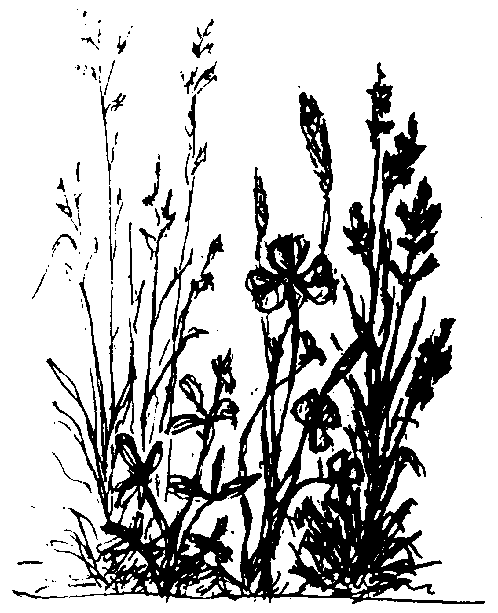
Beneficial Blend Seed Mix
Cereal rye grain, barley, subterranean clover, common vetch, crimson clover, alfalfa, mustard, carrot, annual white clover, yellow sweet clover, cilantro (coriander), caraway, fennel, white yarrow, dwarf white alyssum, buckwheat, annual baby’s breath, baby blue eyes, bishop’s flower, tidy tips. Plant one ounce per 275 square feet. Mow or weedwhip alternately to concentrate beneficials and not drive them away.
|
|

