|
|
|
|
|
Delphastus
catalinae Whitefly Predator PO Box 1555, Ventura, CA 93002 800-248-2847 *
805-643-5407 * fax 805-643-6267 questions bugnet@rinconvitova.com orders orderdesk@rinconvitova.com web
www.rinconvitova.com |
|
|
|

The Whitefly Predatory Lady Beetle, Delphastus catalinae, is being used in greenhouses mainly for
control of sweetpotato whitefly. Initial studies show Delphastus is most effective at high whitefly densities, best used
as an inoculation in greenhouses in combination with other biological controls.
Target
Pests
Greenhouse
whitefly (Trialeurodes vaporariorum)
Banded-winged
whitefly (Trialeurodes spp.)
Sweetpotato
whitefly, silverleaf whitefly (Bemisia
spp.)
Woolly
whitefly (Aleurothrixus floccosus)
Azalea and
hibiscus whitefly (Pealius spp.)
Cloudywinged,
citrus and Rhododendron whitefly (Dialeurodes
spp.)
Citrus
blackfly (Aleurocanthus woglumi)
Description
|
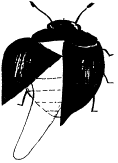
Delphastus
is a native predatory coccinellid beetle often found associated with high
populations of various species of whitefly. ·
Adults
are tiny, 1.4 mm (1/15 inch) long, dark brown to black, hemispherical
beetles; females have reddish yellow heads, lighter colored than males. ·
Larvae
are elongated, cream colored, covered with short fine hairs and have
conspicuous legs, the pupae are more yellow and spherical. The adult beetles fly, while
larvae are slow moving and travel from plant to plant on leaves. Adults are
most noticeable at twilight and on cloudy days. Beetles bite through the
whitefly integument of all stages of whitefly and extract the contents
leaving collapsed integument behind. |
|
Use in
Biological Control
·
Delphastus
is used to control whiteflies in tropical and semi-tropical plantings as well
as commercial vegetable greenhouses.
·
Delphastus
avoids feeding on parasitized whiteflies, therefore is compatible with the use
of Encarsia spp. and Eretmocerus spp. whitefly parasites.
Delphastus also tends to feed in high density whitefly populations, while
parasites do best at lower densities of whiteflies.
·
Optimum
conditions are moderate to high temperatures of 61-90º F (16-35º C); Delphastus
do not fly at temperatures below 55º F (13º C).
·
Delphastus
do not diapause. In mild winters, they will survive medium frosts. Prolonged
temperatures below freezing will kill them.
·
Low
light levels and low temperatures slow down the reproductive rate, but they
will still cycle
Monitoring Tips
Inspect the undersides of leaves in whitefly “hot spots” for
all stages of beetles.
·
Three
weeks after the first introduction, expect to see larvae and pupae on the
underside of leaves.
·
Delphastus
prefer eggs. The first place to scout for Delphastus is in the growing tips,
where the whiteflies are laying their eggs. Look for them 4-5 weeks after
introduction.
·
Two
months after the first introductions, all stages of Delphastus should be
present in the oldest whitefly infested areas.
·
Feces
(watery or pasty yellowish deposits) are a sign of feeding activity.
Life Cycle
The
complete life cycle takes 25-21 days at 78-86o C (25-30o F).
·
Eggs are
yellowish ovals, laid on end, in clusters on the underside of leaves. Females
lay 2-6 eggs per day, and can lay over 300 eggs in their 65-day life time.
Females must eat 100-150 whitefly eggs per day to initiate and sustain egg
laying.
·
Larvae
feed for 7-10 days. Older larvae migrate down the plant to pupate. Pupae are
often found clustered along leaf veins on the undersides of leaves.
·
Adults
emerge from pupae in 6 days. Adults can eat 150-640 whitefly eggs or 11 large
larvae per day. A single beetle can consume as many as 10,000 whitefly eggs or
700 larvae during its lifetime.
·
Both
adults and larvae feed on whitefly eggs and immature stages. If food is scarce,
they will also feed on other small arthropods, such as spider mite and aphids,
and will cannibalize their own species.
Product Information
Delphastus are sold in small containers of 100 or 1,000
adults. They are shipped in shredded paper or other packing material to protect
them during transport. Mortality in these containers should be less than 10%.
Once the beetles warm up they become active immediately,
therefore should be released as soon as possible.
If necessary, beetles can be stored for 1-2 days at 50-61º F
(10-16º C), but longer storage will reduce egg laying.
Introduction Rates
Introduce Delphastus in whitefly infested areas of the
greenhouse as soon as whiteflies are detected.
General introduction rate:
·
Release at least 100 adults/whitefly “hot spot”, or 10
adults/infested plant, weekly, for 3-4 weeks. Preventive rate is 100 per 2.5 acres
(1 hectare), every 2 weeks.
Greenhouse
cucumber, pepper and tomato:
·
Low
Rate: use general rate (above), or 0.5
beetles/m2 (10 ft2), bi-weekly, for 3 weeks
·
Moderate
Rate: 500 Delphastus/whitefly hot spot; or 1-2 beetles/ m2, weekly,
for 4 weeks.
·
High Rate:
500 Delphastus/whitefly hot spot; or 3-4 beetles/ m2, weekly, until
established in all infested areas.
Tropical
Plantscapes
·
Low
Rate: use general rate (above) or 0.5
beetles/m2 (10 ft2), bi-weekly, for 3 weeks
·
Moderate
Rate: 500 Delphastus/whitefly hot spot, weekly, for 4 weeks.
·
High
Rate: 500 Delphastus/whitefly hot spot, weekly, until established in all
infested areas.
For Best Results
·
Best results are achieved when Delphastus is used together
with whitefly parasites (for information on Encarsia; or Eretomocerus.
·
Green lacewing can be released at low whitefly densities
before Delphastus inoculations allowing a generation or two of lacewing to
manage pests early. Lacewing larvae may eat beetle eggs if plentiful relative
to plant-feeding host foods, such as whitefly, aphids and mealybugs.
·
Delphastus do not survive in the absence of prey, therefore
should be released only after whiteflies are detected.
·
Check for Delphastus when de-leafing or pruning leaves from
infested plants. Keep any leaves with Delphastus pupae in the greenhouse until
adult beetles have emerged.
·
Release the Delphastus at sundown on the day they arrive.
Ideally, inoculate when there are less than six whitefly immatures per leaf
with temperatures between 65-90º F. Adults tolerate 45º to 105º F
Using Pesticides
For effects of specific pesticides on Delphastus see the
pesticide toxicity sheet.
·
Broad spectrum and systemic insecticides are toxic to
Delphastus.
·
Spreader-stickers and wetting agents may harm the beetles on
contact, but do not have residual effects.
·
Insecticidal
soap and kinoprene (Enstar®) may be used in whitefly hot spots, however,
reducing whitefly numbers with pesticides also reduces the beetle’s food supply
and reproductive ability.